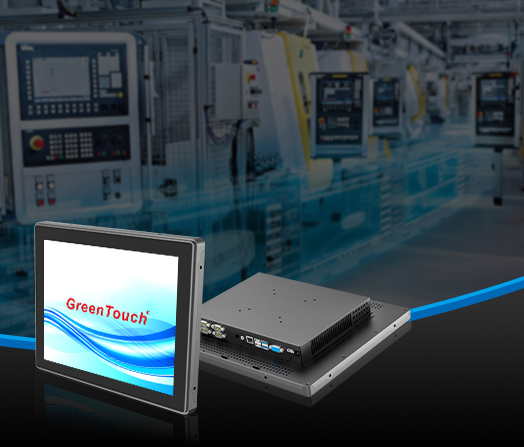
In the industrial touchscreen display industry, CE certification is a mandatory requirement for products to enter the EU market and serves as authoritative evidence that a product complies with the EU’s core standards for safety, health, and environmental protection. For industrial touchscreen display companies expanding into the EU market, CE certification is not an optional qualification but a fundamental requirement for ensuring product compliance, mitigating business risks, and enhancing brand competitiveness. Its importance spans all aspects of product trade, quality, and branding, as detailed below:
I. Establishing a Solid Compliance Foundation to Mitigate Cross-Border Legal and Market Risks
The CE mark is the core symbol of product compliance recognized by the EU market. Industrial touchscreen products that have not obtained CE certification or affixed the CE mark are strictly prohibited from circulation and sale within the EU region. Companies will face multiple substantial operational risks, resulting in direct economic losses and damage to their brand reputation:
1. Customs Clearance Obstacles: Products cannot pass EU customs inspections and are highly likely to be detained or forcibly returned. In severe cases, goods will be destroyed, incurring high logistics and disposal costs.
2. Market Sales Ban: If products enter the EU market, they will be forcibly removed from shelves, seized, and banned from sale upon inspection by regulatory authorities, resulting in the complete loss of local market access.
3. Full Legal Liability: If uncertified products cause equipment malfunctions or safety incidents, the company will bear full legal and compensatory liability in the event of consumer complaints, reports from competitors, or legal proceedings, facing substantial fines and penalties.
II. Standardizing Product Quality and Strengthening Core Technical Compliance Standards
CE certification is not merely a formal qualification; rather, it establishes strict technical specifications for industrial touchscreen products across dimensions such as electrical safety, electromagnetic compatibility, and environmental performance. This ensures the stable and safe operation of products in complex industrial environments. The core compliance standards encompass three major areas:
1. Electromagnetic Compatibility (EMC) Standards: Designed to adapt to complex electromagnetic environments such as factories and production lines, these standards ensure the stable operation of industrial touchscreen devices. They prevent issues like stuttering, freezing, or malfunction caused by external electromagnetic interference, while also preventing the device’s own electromagnetic radiation from interfering with surrounding industrial equipment, thereby ensuring the normal operation of the entire industrial system.
2. Low Voltage Directive (LVD) Standards: Rigorously testing core metrics such as electrical insulation and heat resistance to eliminate potential hazards like electrical leakage, short circuits, and overheating. This effectively prevents safety incidents such as electric shock and equipment fires, ensuring the safety of both personnel and production equipment.
3. RoHS Environmental Directive: Strictly restricts the use of harmful heavy metals such as lead, mercury, and cadmium, as well as other hazardous substances. This complies with the EU’s green environmental access requirements, reduces environmental hazards during product use and recycling, and aligns with EU green trade regulations.
III. Empowering Brand Development and Enhancing Core Competitiveness in International Markets
From a legal perspective within the EU, affixing the CE mark signifies the manufacturer’s official declaration that the product complies with the EU’s comprehensive compliance standards, and it holds legal validity. On one hand, CE certification serves as the basic entry requirement for supply chain tenders by major local clients and leading enterprises in the EU, acting as the key stepping stone for companies to access high-end EU markets and secure cooperation opportunities. On the other hand, in subsequent trade collaborations and quality disputes, the CE certification certificate functions as a legally binding technical credential. It effectively delineates liability, safeguards the company’s legitimate rights and interests, continuously builds brand credibility, and enhances the product’s international recognition and market competitiveness.
IV. Avoiding Compliance Pitfalls: Key Implementation Details for CE Certification
To ensure that CE certification is genuine, valid, and compliant—and to avoid compliance risks resulting from invalid certification—manufacturers of industrial touchscreen displays must pay close attention to three core details:
1. Accurate Matching of Environmental Classes: Class A is suitable for standard industrial applications; however, if the product is intended for residential, office, or other civilian areas, it must meet the stricter Class B limits. Mismatching of classes is strictly prohibited, as it will render the certification invalid.
2. Distinguish Certification Standards for Wireless Functions: Industrial touchscreen displays equipped with wireless functions such as Wi-Fi, Bluetooth, or 4G no longer fall under standard EMC regulations. They must comply with the Radio Equipment Directive (RED), which requires specialized, independent testing of radio frequency performance and imposes stricter certification requirements.
3. Standardize CE Marking Placement: The CE mark must be at least 5 mm in height, and the mark’s proportions must not be distorted or altered. Under normal circumstances, it must be permanently affixed to the product itself; only in special cases where physical space is limited may an electronic display be used to show the mark as a compliant alternative.
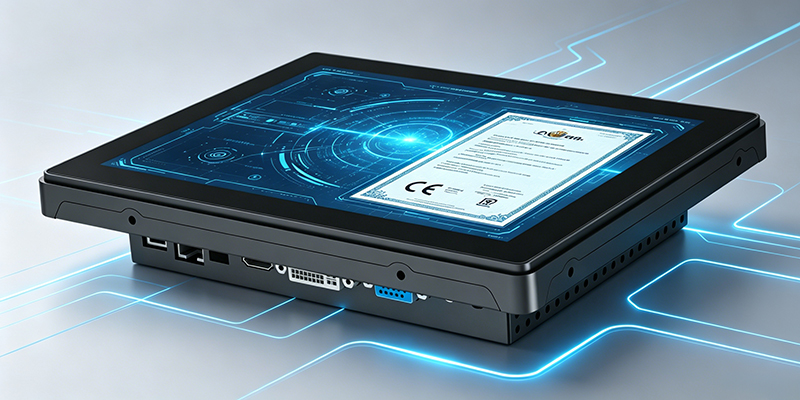
CE certification is the minimum compliance requirement for industrial touchscreen displays entering the EU market. It serves as an authoritative endorsement of product safety, quality, and environmental performance, and is crucial for companies to establish a foothold in the international market, enhance brand competitiveness, and mitigate business risks. Achieving CE compliance and implementing standardization are essential prerequisites for industrial touchscreen display companies seeking to expand their presence in the EU market.

 Español
 Portugues
 Pусский
 Français
 한국어
한국어 العربية
 中文
中文