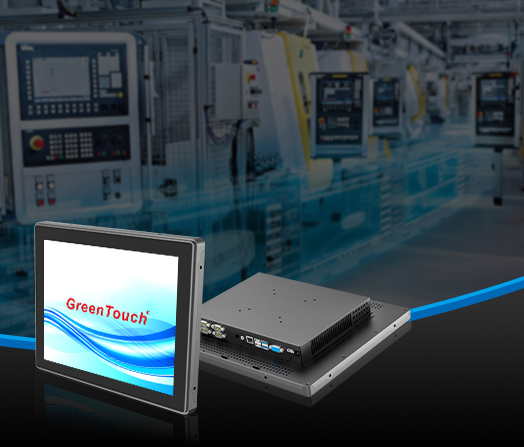
Shenzhen, 18 March 2026 — Despite fierce competition in the touchscreen technology sector, resistive touchscreens are set to undergo dual upgrades in both technology and applications in 2026, thanks to their unique environmental adaptability and interactive characteristics. The latest industry data indicates that, through technological breakthroughs such as utilising inherent physical properties for pressure sensing and replacing traditional ITO with new conductive materials, resistive touchscreens are seeing increasingly widespread adoption in demanding environments such as industry and healthcare, whilst the market structure is further optimising towards high value and high reliability.
Core Technology Evolution: From ‘Single-Point Positioning’ to ‘3D Interaction’
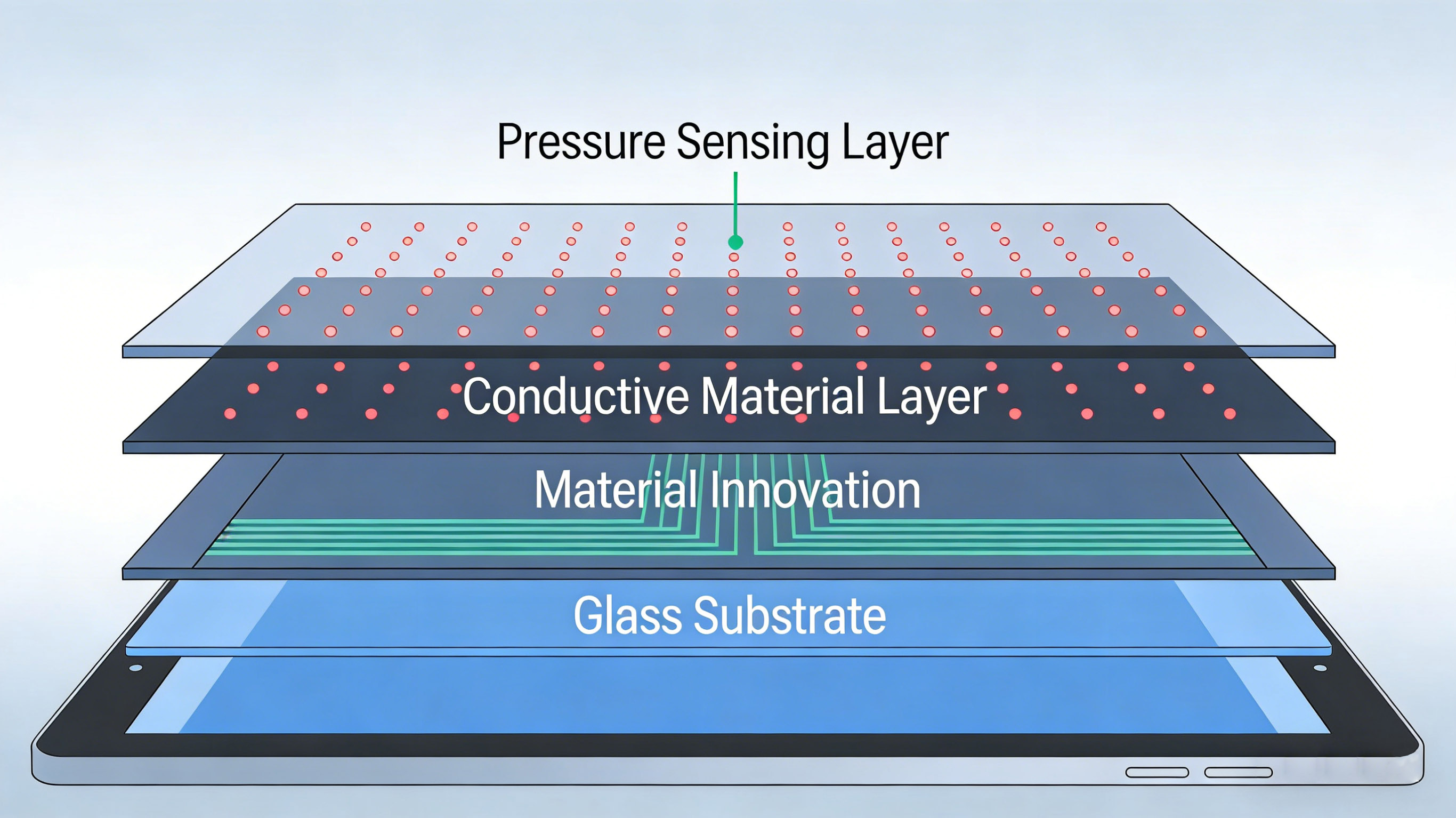
In 2026, the core breakthroughs in resistive touchscreens are centred on two key dimensions: functional upgrades and material innovation. Traditional resistive screens rely on pressure contact between two layers of transparent conductive film to achieve coordinate positioning, whereas this year the industry has achieved pressure-sensing with varying levels of sensitivity at zero hardware cost through algorithm optimisation.
Based on Holm’s Contact Theory, the research team discovered that contact resistance is inversely proportional to pressure (Rc∝1√F). Within a five-wire resistive touchscreen architecture, there is no need to add new components such as force-sensitive resistors (FSRs); instead, by simply repurposing the ADC (analogue-to-digital conversion) signals from the touch detection pins, it is possible to accurately capture the difference in force between a ‘light touch’ and a ‘firm press’. Following software calibration and dual verification through dynamic normalisation and coordinate stability, the system achieves three-level pressure recognition. It has been successfully applied in industrial HMIs and medical devices, resolving the challenge of precise command input when operating whilst wearing gloves.
At the materials level, substantial progress has been made in developing alternative conductive layer solutions. Traditional ITO (indium tin oxide) is limited in its applications due to its high brittleness and poor flexibility. By 2026, graphene composite conductive films and silver nanowire technology will gradually enter the pilot production and small-batch mass production stages. Among these, graphene composite films achieve a bending radius of less than 3 mm and a light transmittance of 86%, making them suitable for military portable terminals; silver nanowires, meanwhile, enhance the flexibility and durability of the conductive layer and are currently undergoing adaptation and validation in outdoor industrial control and in-vehicle scenarios, with the potential to overcome the material bottlenecks of traditional resistive touchscreens.
Market Landscape: Continuous Structural Optimisation, Focus on Essential Demands in Specialised Applications
According to data from industry research institutions, the Chinese resistive touchscreen market reached 3.12 billion yuan in 2025, with a compound annual growth rate of approximately 4.1%. Entering 2026, the market exhibits characteristics of ‘slight overall growth and structural upgrading’, with the proportion of high-end models increasing significantly.
In terms of product structure, shipments of five-wire and higher-wire, long-life resistive touchscreens are expected to account for over 73.6% of the market, completely replacing traditional four-wire screens. Five-wire screens integrate the sensing electrodes into the lower glass substrate, retaining only the upper PET layer as the flexible sensing layer. This improves linearity to within ±1.5% and extends the touch lifespan to over 5 million cycles, making them the mainstream choice in high-frequency operation scenarios such as industrial automation and medical equipment. Meanwhile, the G/G (glass-on-glass) structure, owing to its scratch- and impact-resistant properties, is seeing rapidly increasing penetration in high-wear scenarios such as outdoor equipment and rail transport.
Application scenarios continue to converge towards high-reliability sectors. Industrial automation remains the largest application market, with its share projected to reach 42% by 2026, driven by steady demand growth fuelled by the upgrade to smart manufacturing and the widespread adoption of the Industrial Internet of Things (IIoT). In the medical equipment sector, customised resistive touchscreens—which support operation with sterile gloves and withstand repeated alcohol wiping—account for 74% of the market, serving as the core interactive solution for equipment such as operating theatre monitors and anaesthesia machines. Furthermore, in extreme environments such as rail transport (e.g., the Fuxing high-speed train), power dispatch and smart mining, resistive touchscreens retain an irreplaceable, essential status due to their resistance to electromagnetic interference and wide operating temperature range (-40°C to +70°C).
Industry Ecosystem: Deepening Local Supply Chains, Focusing on Differentiated Competition
China’s resistive touchscreen industry has established a dual-core cluster structure centred on the Pearl River Delta and the Yangtze River Delta. Guangdong and Jiangsu provinces together account for over 70% of production capacity, whilst cities such as Shenzhen, Dongguan and Suzhou have formed a complete localised supply chain spanning from ITO conductive films and glass substrates to module lamination, significantly optimising response efficiency.
The process of supply chain self-reliance is accelerating, with the domestic production rate of key upstream materials rising steadily. The proportion of domestically produced ITO conductive films has reached 58%, whilst the share of domestically produced specialised driver chips in shipments has exceeded 52%. Leading enterprises such as Xinyi Optoelectronics, Yecheng Technology and Heilitai have, through mergers and acquisitions as well as vertical integration, increased the industry concentration (CR5) to 58%, establishing a comprehensive advantage in terms of technological iteration and cost control. At the same time, companies are focusing on scenario-based customisation, developing specialised modules with explosion-proof, salt-fog-resistant and high-vibration-resistant features for strategic clients such as State Grid and CRRC, thereby further enhancing product value-added.
Although resistive touchscreens are no longer the mainstream in consumer electronics, they are being revitalised by technological innovation. From ‘functional upgrades’ in pressure sensing to ‘performance breakthroughs’ in new materials, and on to ‘self-reliance and control’ within the domestic supply chain, the resistive touchscreen industry in 2026 is employing differentiated competitive strategies to consolidate its core position in demanding environments, providing stable and reliable human-machine interaction solutions for sectors such as smart manufacturing and healthcare.

 Español
 Portugues
 Pусский
 Français
 한국어
한국어 العربية
 中文
中文