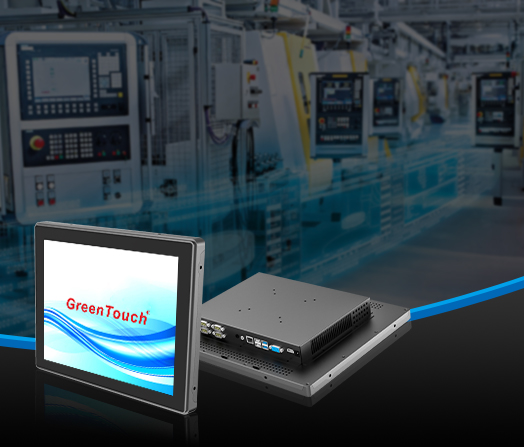
On an automated production line, washdown can expose gaps in a panel seal, a dropped tool can crack the cover glass, and electrical noise from a nearby drive can disrupt touch input. Each failure starts in a different part of the system, but all can take the operator interface offline.
GreenTouch develops custom industrial touch monitors for OEMs and system integrators working in automation, food processing, chemical processing, outdoor self-service and transportation. The engineering team designs the cover glass, mounting seal, electromagnetic compatibility (EMC) and passive cooling around the conditions the display will face once it is installed.
GreenTouch uses chemically strengthened cover glass in configurations designed to achieve IK08 impact resistance. IK08 corresponds to an impact energy of 5 joules, approximately equivalent to a 1.7 kg impact element falling 300 mm. The rating helps integrators specify a front panel for locations where dropped tools, equipment contact or deliberate impact are foreseeable.
Cover glass specifications include a surface compressive stress of at least 450 MPa and a depth of layer of at least 30 μm. GreenTouch can specify 3 mm, 4 mm or thicker cover glass for outdoor equipment and installations subject to frequent vibration or mechanical contact.
Surface treatments can be combined to suit the lighting and cleaning requirements of the application.
| Surface treatment | Specification and purpose |
|---|---|
| Anti-glare (AG) | An etched finish with a gloss level of 60–90 GU diffuses reflections from sunlight and overhead lighting. |
| Anti-reflective (AR) | A coating reduces surface reflectance to 1.5% or less to improve display contrast in bright environments. |
| Anti-fingerprint (AF) | An oleophobic treatment with a water contact angle of at least 110° helps reduce oil adhesion and makes fingerprints easier to wipe away. |
The front-panel seal depends on the enclosure opening, gasket material and clamping pressure. GreenTouch uses closed-cell silicone or EPDM gaskets with a Shore A hardness of 40–60. The seal is designed to retain compression and rebound through temperature cycling from −20°C to +70°C, while controlled clamping pressure helps prevent deformation of the LCD panel.
| Mounting option | Typical integration |
|---|---|
| Open-frame | Side brackets secure the display inside a kiosk or equipment enclosure. |
| VESA mount | 75 × 75 mm or 100 × 100 mm mounting patterns with M4 threaded inserts support articulated arms and other compatible brackets. |
| Panel mount | Rear clamps compress the gasket against the enclosure panel. For the described clamp design, the recommended tightening torque is 0.8–1.2 N·m. |
IP65 applies to the front glass and bezel after correct installation. The standard rear housing is rated IP20 and is intended for installation inside a protective enclosure.
Variable-frequency drives, contactors and high-power modules can introduce interference that shows up as erratic touch coordinates, display artifacts or intermittent USB and video connections. GreenTouch addresses these issues at the chassis, grounding and cable levels. EMC design targets include EN 55032 for emissions and EN 61000-4-2 for electrostatic discharge immunity, subject to the requirements of the project.
A galvanized steel or aluminum chassis shields sensitive electronics. Where appropriate for the system, a star-grounding layout provides a common low-impedance reference for the display chassis, touch controller and industrial host. Double-shielded video and USB touch cables with ferrite cores help preserve signal integrity on longer cable runs.
Industrial DC configurations use a 9–36 V DC input with overvoltage, overcurrent, reverse-polarity and surge protection to help manage disturbances on the power supply.
For sealed configurations, GreenTouch uses a fanless design that conducts heat from the timing controller and power components to the aluminum rear housing. Thermal pads with a conductivity of 2.0–3.5 W/(m·K) couple the components to the heat sink. Rear fins spaced 15–25 mm apart then dissipate heat by natural convection into the surrounding cabinet air.
The described thermal configuration targets a thermal resistance of 1.2°C/W or less and can achieve a mean time between failures (MTBF) of more than 50,000 hours. Cabinet temperature and clearance around the rear heat sink are part of the thermal evaluation because they affect how much heat the display can dissipate once installed.
GreenTouch and the system integrator define acceptance criteria before tooling. These can include allowable pixel defects, optical transmittance, touch-coordinate accuracy, gasket compression and the applicable compliance tests.
Integration testing uses the customer’s intended enclosure, mounting arrangement and cable routing. It checks for changes in capacitive touch behavior caused by nearby metal, verifies uniform gasket compression around the full perimeter, and assesses cable strain and fatigue under vibration. Testing the installed assembly gives both teams a chance to address integration issues before pilot production.
The IP65 rating applies to the front glass and bezel when the display is installed and sealed as specified. The standard IP20 rear housing must be installed inside a protective enclosure.
IK08 corresponds to a 5-joule impact test. For an industrial touch monitor, it provides a defined benchmark for assessing front-panel resistance to impacts such as dropped tools and accidental equipment contact.
The described industrial DC models accept 9–36 V DC and include overvoltage, overcurrent, reverse-polarity and surge protection.
For OEMs and system integrators, GreenTouch supports the project from glass and coating selection through enclosure integration and validation of the installed display. Share the enclosure drawings, operating conditions and acceptance requirements with the engineering team to define a configuration for your application.

 Español
 Portugues
 Pусский
 Français
 한국어
 العربية
 中文